
The technology
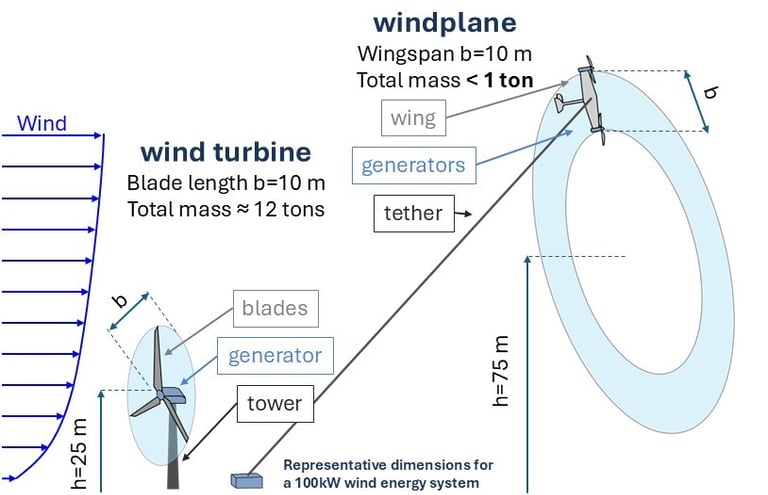
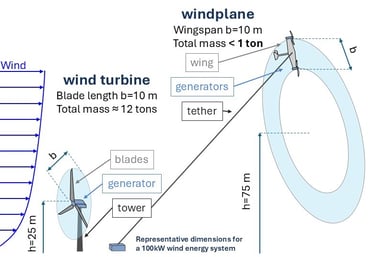
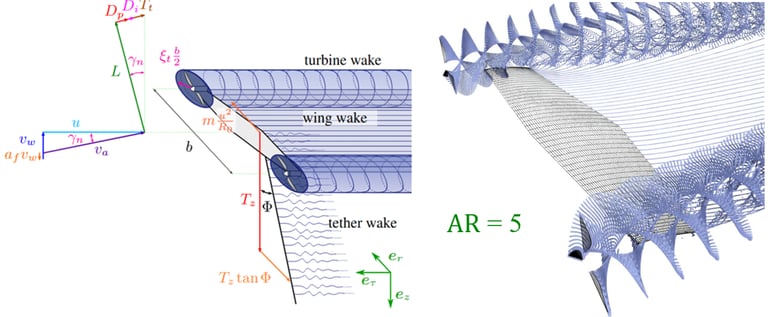
Windplanes generate electricity by flying in fast crosswind loops, with the onboard turbines generating the electric power.
By operating at higher altitudes, they access stronger and more consistent winds than conventional small wind turbines.
Their circular flight path sweeps a much larger area than a conventional rotor of similar size, increasing energy capture potential.
The tether transfers the aerodynamic forces to a lightweight ground station that manages launch, landing, and power systems.
For the same power output, windplanes can use less than 10% of the material required by tower-based turbines, making them a compact and scalable solution for distributed clean energy.
Our approach
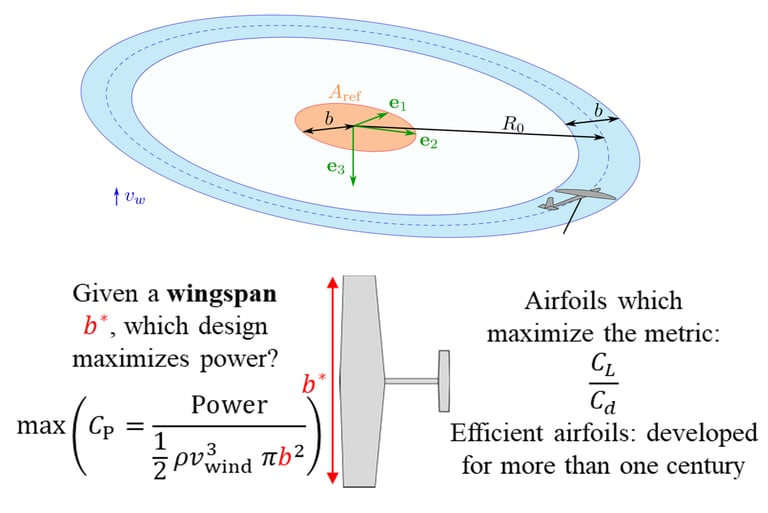
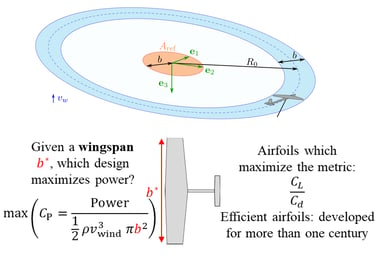
Our technology is built on a new groundbreaking aerodynamic design methodology, developed in Trevisi’s PhD thesis (awarded by the European Academy of Wind Energy), and by advanced control methodologies, developed by the research group.
By designing the windplane for a new power coefficient, we unlock a system that features conventional technologies:
Low aspect ratio wings, similar to conventional airplanes, improve power performances, controllability, structural design.
Conventional high‑efficiency airfoils, used by airplanes and wind turbines.
Simpler and lighter structural design, thanks to the low aspect ratios and the conventional airfoils.
Robust and safe control methods, tailored to the new design, which maximize power capture.
Onboard turbines optimized for low induction and low tip‑speed ratios, increasing efficiency and reducing noise.
Power generation
Take-off and landing
Our take-off and landing strategy is robust, economic and scalable to any windplane size.
This approach is protected by 2 submitted patents on key enabling technologies. Reach out to us to know more
Selected scientific references
Trevisi, F., Cassoni, G., Gaunaa, M., and Fagiano, L. M.: Concurrent aerodynamic design of the wing and the turbines of airborne wind energy systems, Wind Energ. Sci., 11, 195–216, https://doi.org/10.5194/wes-11-195-2026 , 2026.
M. Alborghetti, F. Trevisi, R. Boffadossi and L. Fagiano, "Optimal Power Smoothing of Airborne Wind Energy Systems via Pseudo-Spectral Methods and Multi-objective Analysis," 2025 European Control Conference (ECC), https://doi.org/10.23919/ECC65951.2025.11187024.
F. Trevisi, L. Jr Sabug and L. Fagiano (2025), A Gaussian wake model for Airborne Wind Energy Systems, Journal of Physics: Conference Series, 3016 012038 https://doi.org/10.1088/1742-6596/3016/1/012038
R. Joshi and F. Trevisi. (2024) Reference economic model for airborne wind energy systems (Version 1). IEA Wind TCP Task 48. https://doi.org/10.5281/zenodo.10959930
F. Trevisi, C.E.D. Riboldi, A. Croce: Refining the airborne wind energy systems power equations with a vortex wake model, Wind Energy Science, 8, 1639–1650, https://doi.org/10.5194/wes-8-1639-2023 , 2023.
F. Trevisi, C.E.D. Riboldi, A. Croce: Vortex model of the aerodynamic wake of airborne wind energy systems, Wind Energy Science, 8, 999–1016, https://doi.org/10.5194/wes-8-999-2023 , 2023
F. Trevisi, I. Castro-Fernandez, G. Pasquinelli, C.E.D. Riboldi, and A. Croce: Flight trajectory optimization of Fly-Gen airborne wind energy systems through a harmonic balance method, Wind Energy Science, 7, 2039–2058, https://doi.org/10.5194/wes-7-2039-2022, 2022
F. Trevisi, A. Croce, C.E.D. Riboldi: Flight Stability of Rigid Wing Airborne Wind Energy Systems. Energies, 14, 7704 (2021). https://doi.org/10.3390/en14227704
L. Fagiano, M. Quack, F. Bauer, L. Carnel, E. Oland. Autonomous Airborne Wind Energy Systems: Accomplishments and Challenges. Annual Review of Control, Robotics, and Autonomous Systems, 5, pp. 603 – 631 (2022). https://doi.org/10.1146/annurev-control-042820-124658
L. Fagiano, S. Schnez, On the take-off of airborne wind energy systems based on rigid wings (2017), Renewable Energy, https://doi.org/10.1016/j.renene.2017.02.023.
Email:
info@ventoplani.com
Ventoplani S.r.l.
Via del Gonfalone 3, 20123 Milan (MI), Italy
VAT / Tax code: 14841940969
Companies Register no. (REA): MI-2810818
© 2026 Ventoplani S.r.l. — All rights reserved